Fit-to-Standard ERP Won’t Save You from Yourself
Template approaches to ERP only pay dividend if you do the work in advance
The pitch is seductive
Fit-to-standard, fit-to-template, template-led delivery, adopt, don’t adapt… Whatever a system integrator calls it, the message is the same: stop trying to make ERP fit your business and make your business fit the ERP. Faster implementation. Lower cost. Less customisation. Easier upgrades.
And honestly the underpinning thinking is sound. Years of bloated, over customised ERP projects have left organisations stuck on legacy systems, terrified to upgrade, paying through the nose for aged user experience and carrying the risk of bespoke customisations and integrations that barely anyone understands any more. The instinct to stop that cycle is correct.
But here’s what no one tells you in the sales cycle: fit-to-standard is not a methodology that avoids complexity – it is a methodology that assumes you’ve already resolved it.
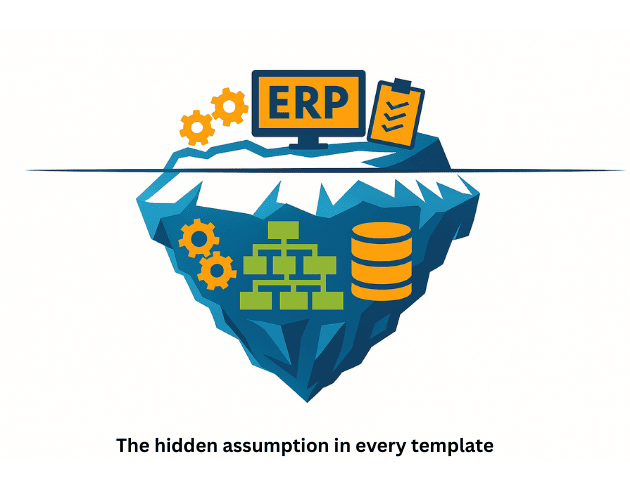
A template led approach works beautifully when an organisation knows how it wants to operate, when process ownership is clear, when data structures are agreed and when business units have aligned on a unified operating model.
In that scenario a well configured template accelerates delivery. You’re not designing from scratch – you’re adopting best practice and making deliberate, informed choices about where to deviate.
The problem is that most organisations going into an ERP programme are not in that scenario. They’re going into it precisely because they lack that clarity. ERP is often the catalyst – the reason the business finally has to get its house in order.
A template doesn’t resolve that ambiguity. It just makes it more expensive to ignore.
Pushing the problem down the road
What tends to happen in practice is predictable:
- The organisation signs a contract with a System Integrator (SI), often under time pressure and with scope and statement-of-work that is deliberately light on detail.
- The SI arrives with their template. Design workshops begin.
- Somewhere around week three, someone says: "Well, in our division, we actually do it differently." Then someone else says the same.
- The debate begins – should the template bend to the business or the business bend to the template, and can all divisions align on a standard approach? Decisions that should have been made before a contract was signed are now being made under programme pressure, at day rates, in rooms full of people with very different incentives.
- Scope expands. Timelines slip. Change requests start arriving.
- The SI – operating well within the terms of a contract that was light on scope definition – is perfectly positioned to charge for every bit of it.
The "fit to standard" programme starts to look a lot like every other ERP programme. You didn't avoid the hard work. You just agreed to do it at the worst possible time.
The ERP contracting trap
There’s a structural problem if you take a fit-to-standard approach to ERP procurement: the point at which organisations are most commercially vulnerable – during contracting – is also the point at which they know least about what they are buying.
Vague scope is usually a feature of this approach – a loosely scoped contract gets signed faster. The SI accepts the risk on paper, knowing that the real negotiation happens later in change requests and knowing the customer is rarely in a position to walk away once they’re 6 months in.
The answer is not to distrust your SI. Most are genuinely trying to do a good job. The answer is to walk into that contracting process with enough structural clarity that the scope is genuinely defined and defensible.
Structure before contracting
The principle is straightforward, even if the practice is uncomfortable: the structural decisions that underpin an ERP programme must be made before you sign anything. Not during workshops. Not when you’re already committed.
What does this actually mean? It means doing the work to define your target operating processes – not just as an aspirational PowerPoint presentation or Visio Process Maps but as a set of concrete decisions about how the business will actually function. It means resolving the question of whether you are genuinely standardising across the organisation or whether there are legitimate differences that need to be honoured and scoped accordingly. It means agreeing on data governance, process ownership and the organisational authority needed to enforce decisions when people push back in workshops.
This work is harder to sell to a board than an ERP programme. There’s no big-bang announcement, no visible system going live but it is, without question, the highest value investment you can make before an ERP programme begins.
The real choice is timing, not effort
Fit to standard is genuinely a good idea. Resisting the urge to customise, challenging the business to adopt good-practice processes, reducing technical complexity – those are the right instincts and the organisations that embrace them are likely to get more from their ERP investments over time. But fit-to-standard is not a shortcut. The structural hard work – the process decisions, the data governance, the stakeholder alignment, the honest conversations about where you are genuinely standardising and where you’re not – does not disappear because you have chosen a templated approach. It just happens sooner.
Do it before you contract and you set your programme up for success. Do it during delivery and you risk paying for it twice: once in the time and cost of the programme and again in the compromised outcome at the end.
The question for any executive heading into an ERP investment isn’t whether to do this work, it’s whether you’re willing to do it up front.
At Lumenia we guide organisations through every stage of the ERP journey – from initial strategy development and system selection through to programme assurance and delivery support. We're independent and product-agnostic which means our advice is shaped entirely by what's right for your organisation, not by any relationship with a vendor or SI. We can also help you design your business processes. If you're at the start of that journey and working through your options we can help you make the right choice. If you're already committed and want a second opinion on your approach before the hard work begins we'd be delighted to talk.
This blog was written by Mark McKeigue, Associate Partner with Lumenia Consulting. If you're interested in exploring how Lumenia could support your ERP selection project, contact Mark directly.