
ERP Training

Get your people ready for the new system from day one

From training strategy and needs analysis through end-⁠user documentation and delivery, we help ensure your people can perform their roles effectively in the new ERP environment.

Book a Call

The challenge

A successful go-⁠live depends on your people using the system

The success of an ERP implementation is ultimately determined by the people who use the system day to day. On the morning after go-⁠live, every buyer, planner, warehouse operative, customer service representative, finance user and manager needs to know how to perform their role in the new environment. If they cannot, the organisation will struggle to realise the benefits it expected from its ERP investment.

Yet ERP training is frequently underestimated. Training is often left until late in the project, delivered using generic vendor materials that do not reflect how the business actually operates, and not tailored to the specific roles and responsibilities of different user groups. Users receive inconsistent training, reference materials are limited, and support teams are left dealing with preventable issues during the critical go-⁠live period.

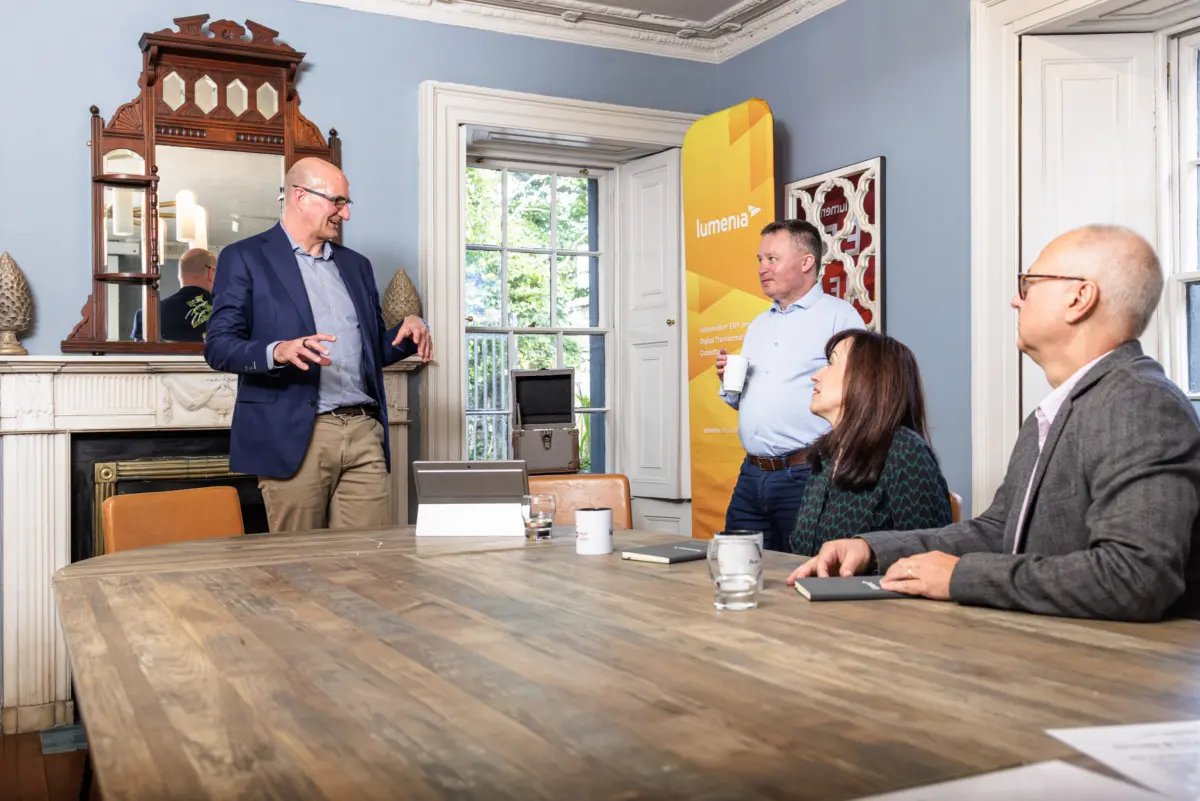
A Lumenia consultant presenting to colleagues around the table

Our approach

A structured approach to ERP training

Lumenia's ERP training approach is designed specifically for ERP implementations. We help organisations plan, develop and deliver training aligned to future-⁠state business processes, project timelines and user roles. Training is treated as a structured workstream, not a last-⁠minute activity.

01

Training strategy

We develop a clear ERP training strategy covering objectives, audiences, delivery methods, environments, success measures and alignment with testing cycles and go-⁠live activities. This provides a framework for all training activities throughout the project.

02

Training needs analysis

A structured training needs analysis identifies who needs training, what they need to learn and how it should be delivered. Users are mapped to the future-⁠state processes and ERP functionality relevant to their roles, ensuring no user group is overlooked and no time is wasted delivering unnecessary training.

03

Training curriculum

We develop a role-⁠based training curriculum that defines courses, learning objectives, prerequisites and learning paths. Training is organised around how people actually perform their jobs rather than ERP modules alone.

04

Detailed training plan

Training requires careful coordination across the wider ERP programme. We develop detailed training plans covering schedules, trainers, facilities, systems access, training environments and participant management, ensuring training takes place at the right time and remains fresh at go-⁠live.

05

End-user documentation & training materials

High-⁠quality training materials are critical to successful ERP adoption. We develop customised quick reference guides, detailed user guides, training presentations and supporting materials tailored to your business processes, terminology and ways of working rather than generic vendor documentation.

06

Training delivery

Training can be delivered through classroom sessions, workshops, virtual training and e-⁠learning approaches, including quizzes, simulations and exercises. Our approach covers both ERP system training and business process training because users need to understand both.

The result

Users who are confident, capable and productive from day one

Users understand both the ERP system and the business processes it supports. They can perform their roles effectively from day one and require less support during the initial post-⁠go-⁠live period.
The organisation begins realising business benefits sooner because users are able to utilise the new ERP system to its full capabilities.
Business processes are executed more consistently across teams and locations, helping to reduce process variation and data-⁠entry errors.
Users feel more confident adopting new ways of working, helping to reduce uncertainty and resistance to the changes introduced by the new ERP system.
Support teams experience fewer avoidable issues during go-⁠live and hypercare because users are better prepared for the new environment.
Training materials remain available after go-⁠live, ensuring future employees can receive the same quality of training without recreating content from scratch.

What you get

What a Lumenia training engagement delivers

Training strategy

A documented ERP training strategy aligned with project objectives, testing cycles and deployment plans.

Training needs analysis

A training needs analysis mapping users, roles, business processes and ERP functionality.

Curriculum & training plan

A role-⁠based training curriculum and detailed training plan covering learning objectives, schedules, trainers, systems access and participant coordination.

End-user documentation

Customised training materials including quick reference cards, detailed user guides, presentations and supporting documentation.

Training delivery support

Classroom, workshop, virtual or e-⁠learning training delivery and support.

Reusable training library

A reusable training library that supports future onboarding and ongoing user development.

Track record

Confident users from day one

Lumenia brought structure, clarity, and real expertise to our change programme as part of our ERP Implementation. Their approach ensured stakeholders were aligned, communications were clear, and training was delivered at the right time for the business. We recommend their change management support services to any organisation undertaking a significant transformation project.
Niall Skehan
Digital Transformation Manager, Merlyn Showering

Common questions

Questions we hear about ERP training

Why does ERP training go wrong?
User training is one of the final activities in most ERP implementations and often receives less attention than it deserves. If users are not adequately trained, organisations struggle to realise expected ERP benefits. Effective training helps users utilise the system properly, reduces errors and supports consistent execution of business processes across the organisation.
What are the drawbacks of the “train-the-trainer” model?
Train-⁠the-⁠trainer has many advantages, but it depends heavily on the quality of the training materials and the capability of those delivering the training. In many ERP projects, project team members are expected to create training content despite having little experience doing so. The result can be inconsistent training and limited supporting documentation. Lumenia addresses this by developing structured, professional training materials and supporting trainers throughout the process.
What training materials do you develop?
We develop customised quick reference cards, detailed user guides, presentations and supporting training documentation that reflect your ERP solution, business processes and operational requirements. These materials can also be reused for onboarding future employees.
Can ERP training be delivered through e-learning?
Yes. Training can be delivered using e-⁠learning approaches including quizzes, simulations and exercises. We can combine e-⁠learning with instructor-⁠led training to provide a blended learning experience. Our approach covers both ERP system training and process training.
Which ERP systems can you support?
We can support ERP training programmes across leading ERP platforms such as SAP, Oracle, Microsoft, Workday, Infor, IFS and Sage. Our methodology focuses on business processes and user roles, making it effective regardless of the ERP solution being implemented.
How much of the training process can Lumenia take on?
We can support all stages of the ERP training lifecycle, from training strategy and needs analysis through curriculum development, training material creation, detailed training planning and training delivery support. Organisations can choose a train-⁠the-⁠trainer approach, direct delivery model or a combination of both.

Next step

Ready to build capability before go-⁠live?

Talk to an independent ERP consultant about your users, training requirements and what it will take to prepare your people for the new system.

Book a Call
Lumenia Consulting
Book a Call

Cookie settings

Choose which cookies we may use. Essential cookies keep the site working and cannot be switched off. You can change your choice at any time from the Cookie settings link at the bottom of every page. Read more in our Cookie Policy.

Strictly necessary

Keep the site secure and working, remember your cookie choice and remember that you have unlocked our publications.

Always active

Functional

Remember preferences such as which homepage photo you saw last, and load the interactive office map and embedded videos without asking each time.

Analytics

Help us understand how visitors use the site so we can improve it (Google Analytics, Microsoft Clarity).

Marketing

Measure our advertising, remember which campaign brought you to the site and show relevant adverts on other websites (Google Ads, LinkedIn).