Business Process Design

Design your future state without starting from a blank page

Business process design is traditionally time-⁠consuming and labour-⁠intensive. Our consultants bring structure, knowledge and practical experience of how ERP enables process change, along with a library of sample process diagrams that significantly accelerates your future state design.

Book a Call

The service

Future state design, accelerated by experience

Business process transformation is one of the primary objectives of many ERP projects, and process design is where that transformation gets defined. As Europe's leading independent ERP consulting company, we have led this work for hundreds of clients.

The most suitable time to design your future state is before you purchase or replace your ERP system. That way your ideal way of operating is clearly defined and factored into the selection and design of the new system.

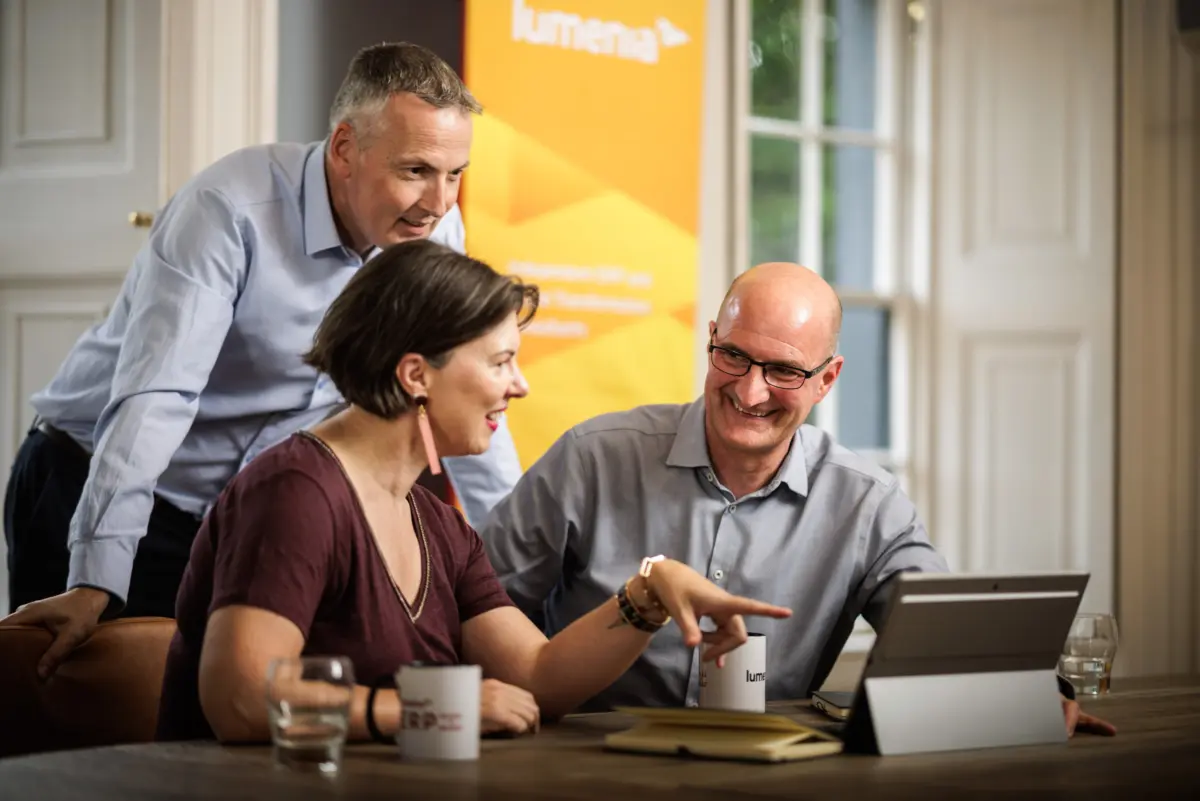
Three Lumenia consultants reviewing a laptop screen together

Business process design

Business process design is the development and documentation of the steps involved in executing a business process. The work is led by an experienced Lumenia consultant in a workshop environment involving the process owner and the subject matter experts. Outputs are captured in Visio during and after each workshop, and a single follow-⁠up review session is often all that is needed to finalise each design.

A ready-made starting point

Rather than starting from scratch, we bring an extensive library of pre-⁠defined process diagrams documented to Level 4, all based on good practice as generally implemented in ERP solutions. After discovering more about your business we will tailor these diagrams in advance of the workshop so that most of the time spent in the workshop will be spent in capturing the nuance of how the business will operate. Our templates also remove the need to document current processes that are going to change anyway.

Our approach

The four steps of business process transformation

01

Find the opportunities

We discover how the business operates and identify opportunities for improvement in the existing processes.

02

Design the to-be processes

We facilitate workshops with process owners and subject matter experts to develop the to-⁠be processes.

03

Map the enabling ERP functionality

We identify the key ERP functionality that will be required to enable the future state processes.

04

Understand the change

We develop a change impact analysis to clarify how much organisational change will actually be involved.

In their words

A different way of thinking about your processes

The result

Process Design diagrams that support the next steps of your ERP journey

To-⁠be process design diagrams support process improvement, help assess vendor capability during selection and accelerate implementation design.

Common questions

Questions we hear about business process design

Do we have to document all our current processes first?
No. In most cases we do not document current processes in full. Pain point analysis and process benchmarking show us where the gaps are, and the time saved is spent designing the future state instead.
How does Lumenia's to-be process library actually speed the work up?
Each workshop starts from a documented process diagram based on good practice as generally implemented in ERP solutions, rather than a blank page. The discussion becomes what to change for your organisation, which reaches agreement in fewer sessions.
What if the ERP system we choose already has best-practice processes built in?
The two are not mutually exclusive. Adopting industry-⁠standard processes is usually more desirable and less costly than customising a system. Design is how you work out where those standards serve you and where your business warrants something different.
How much of our people's time will this take?
Less than you might expect, because we do not document processes that are going to change anyway. Design happens in workshops with the process owner and subject matter experts, and one follow-⁠up review session is often enough to finalise each process.
Who needs to be involved in the design workshops?
The process owner and the subject matter experts who do the work day to day. Cross-⁠functional agreement is fundamental to good design, and a senior Lumenia consultant facilitates each workshop and documents the outputs in Visio.
Do we need to have chosen an ERP system before we design our processes?
No. Designing first means your requirements reflect how you intend to operate, and your future state gives you a sound basis for assessing vendor and product capability. Designs can still be refined during implementation.

Next step

Ready to design your future state?

Set up a call with one of our team to talk about your current processes and how we can accelerate your future state design.

Book a Call

Lumenia Consulting
Book a Call

Cookie settings

Choose which cookies we may use. Essential cookies keep the site working and cannot be switched off. You can change your choice at any time from the Cookie settings link at the bottom of every page. Read more in our Cookie Policy.

Strictly necessary

Keep the site secure and working, remember your cookie choice and remember that you have unlocked our publications.

Always active

Functional

Remember preferences such as which homepage photo you saw last, and load the interactive office map and embedded videos without asking each time.

Analytics

Help us understand how visitors use the site so we can improve it (Google Analytics, Microsoft Clarity).

Marketing

Measure our advertising, remember which campaign brought you to the site and show relevant adverts on other websites (Google Ads, LinkedIn).